

What 6,000 Runners Taught Us About Getting to the Start Line
Race data from over 6,000 runners and a survey of 600: finish times, first-timers, training volume, women in ultras and who comes back. Ultra X, 2026
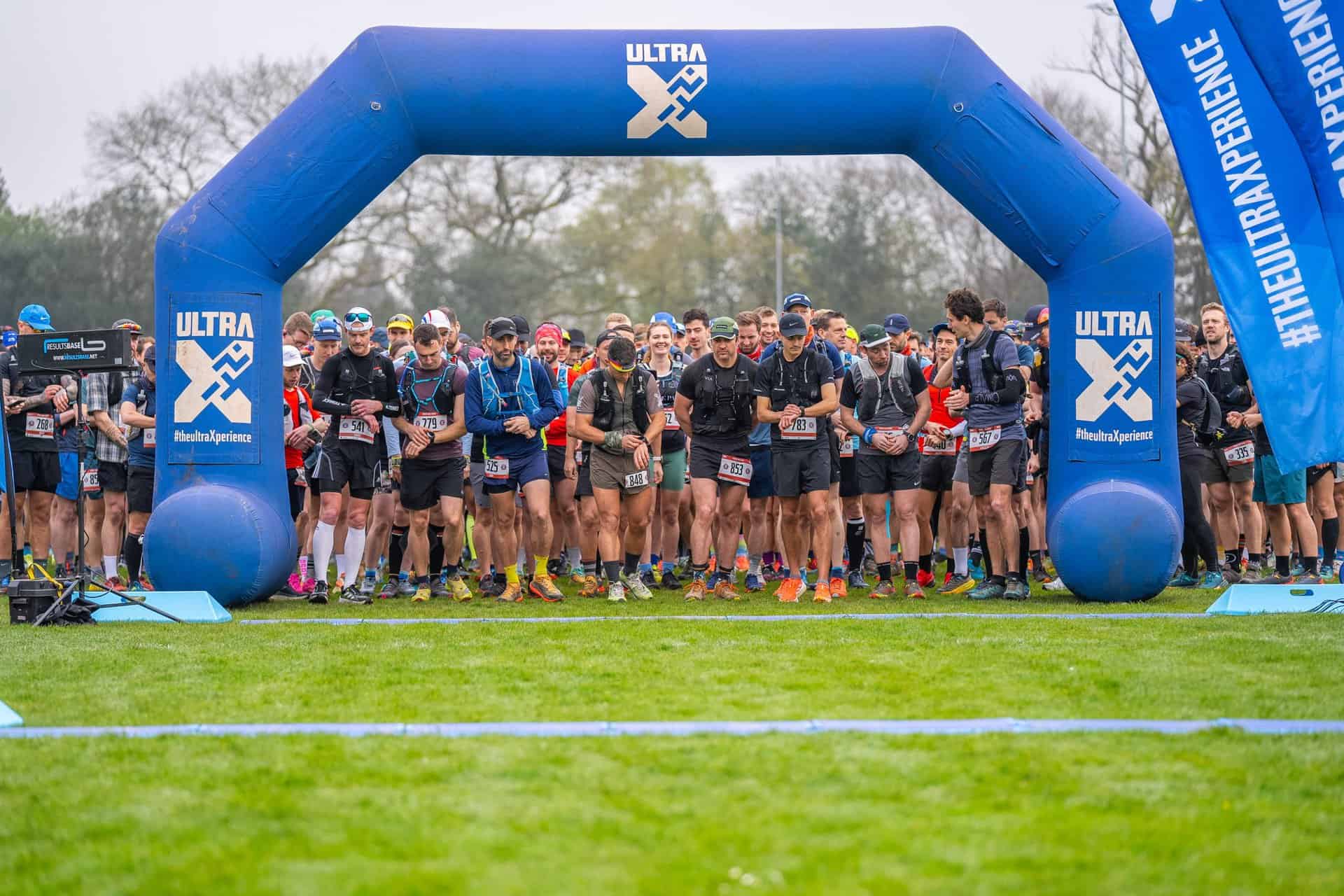
More than 6,000 people finished an Ultra X event in the last year, across four continents, 10 countries and every distance from 10km to 330km.
We’ve learnt a lot from those runners and we want to share some of that here. We’ve learnt from our participant data and our timing results, which cover every finisher at every race: where they came from, how long they took and whether they had raced with us before. We’ve also learnt from the questionnaire we send after each event. Around 600 runners at our 2026 UK races answered it, telling us how they trained, why they entered and whether they plan to come back.
The race data tells us who turns up and how they get on. The survey tells us how they got there. Together they say the same thing: the start line of an ultra is a lot less daunting, and a lot more welcoming, than most people expect.
Key findings
- More than 6,000 runners took part in 46 Ultra X races in 10 countries. Finishers came from 83 countries, and 31% were from outside the UK.
- Overall, 39% of finishers were women, ranging from 57% at 12km to 22% on the 110km single stage.
- The median finisher completed a 50km in 7 hours 38 minutes, the fastest completed in 3 hours 53 minutes and the slowest took just over 14 hours.
- 38% of surveyed runners were running their first ultra, rising to 54% at 50km.
- First-timers trained a median of 42km (26 miles) a week in the four months before their race.
- 87% of surveyed runners said they were likely or certain to race with us again within two years. 31% of this year’s finishers already had.
Who runs an Ultra X race?
The start line at an Ultra X race is a truly international one. Last year, finishers came from 83 countries and almost one third (31%) were from outside the UK. After Britain the biggest groups came from France, the Netherlands, the USA, Finland, Ireland and Germany.
The races themselves ranged from 12km and 25km trail races, through 50km, 60km and 110km ultras in the UK and Europe, to week-long stage races overseas.
How many ultra runners are women?
39% of our total finishers were women. The share is highest at the shorter distances and falls as the races get longer, with one notable exception.
| Distance | Women (share of finishers) |
|---|---|
| 12km | 57% |
| 25km | 51% |
| 50km | 38% |
| 60km | 31% |
| 110km two-day multi-stage | 43% |
| 110km single stage | 22% |
| All races | 39% |
That exception is the 110km multi-stage race. Over two days, with a night in camp, 43% of finishers were women. In one go, it was 22%. The distance is the same, but the share of women finishing it is almost twice as high for the two-day event.
How long does an ultra take?
These are the finish times across all of our races at each distance in the last 12 months. Courses vary between events, so treat them as a guide rather than a target for any single race.
| Distance | Median finisher | Fastest | Slowest |
|---|---|---|---|
| 25km | 3h 32m | 1h 42m | 13h 29m |
| 50km | 7h 38m | 3h 53m | 14h 05m |
| 60km | 9h 54m | 5h 13m | 17h 50m |
| 110km single stage | 19h 32m | 10h 10m | 35h 16m |
| 110km two-day multi-stage (cumulative) | 17h 52m | 10h 09m | 28h 45m |
| Week-long stage races (cumulative) | 35h 37m | 16h 44m | 52h 27m |
The number to notice is the gap between fastest and slowest. On the 50km, the slowest finisher took more than three times as long as the winner and still got a medal. Finishing an ultra is not about pace. Plenty of the field walk a good part of the course, and cut-offs are set so that a steady hiker can make them.
How many runners are on their first ultra?
Our survey asks whether runners have done an ultramarathon before. Of the respondents who ran a 50km, 60km or 110km with us in 2026, 38% had not.
| Distance | First ultra |
|---|---|
| 50km | 54% |
| 60km | 44% |
| 110km two-day multi-stage | 16% |
| 110km single stage | 17% |
The 50km number is the one that matters. More than half the field at our entry-level ultra distance had never run an ultra before. That is the whole point of the distance, and it is doing its job.
The race data backs this up from a different angle. Only 15% of this year’s 50km finishers had finished an Ultra X event in a previous year, so for most of the field it was their first race with us.
The 110km figures surprised us too, but in the opposite direction. One in six people taking on 110km, in one go or over two days, had no ultra behind them. They are not the norm, but they are not rare either.
How much do first-time ultra runners train?
We ask runners how many kilometres a week they ran in the four months before the race. The honest answers are lower than most training plans would have you believe.
| Distance | Median weekly training |
|---|---|
| 25km | 30km (19 miles) |
| 50km | 47km (29 miles) |
| 60km | 45km (28 miles) |
| 110km two-day multi-stage | 58km (36 miles) |
| 110km single stage | 60km (37 miles) |
Split by experience, first-timers on an ultra distance reported an average of 42km (26 miles) a week. Runners with at least one ultra behind them did 55km (34 miles). Half of all first-timers were training on 40km a week or less, and only one in ten did 70km or more. Among returning ultra runners, nearly three in ten were at 70km plus.
That is not to say 40km a week is enough to enjoy a 110km. The 110km first-timers trained at 60km a week, the same as the experienced runners alongside them. But for a 50km or 60km, the evidence from our own start lines is that three or four runs a week, done consistently for four months, is what most people actually turn up with.
Do ultra runners come back?
We ask runners how likely they are to do another Ultra X event within two years, on a scale of one to four. 55% said definitely, and 87% said likely or definitely.
The most useful number is that first-timers and experienced runners answered almost identically: 55% and 56% definitely. A first ultra does not put people off. On the contrary, first-timers are just as likely to say they will be back as people who already knew what they were signing up for.
The race data shows how that plays out. 31% of this year’s finishers had finished an Ultra X event in a previous year, and 9% did two or more of our events within the same 12 months. Returners are more common the longer the race:
| Distance | Finishers who had raced with us before |
|---|---|
| 50km | 15% |
| 110km | 29% |
| Week-long stage races | 38% |
| All races | 31% |
It suggests a ladder many runners climb: start at 50km, come back for the 110km, and keep going until they reach the week-long stage races.
By distance, the 60km and 25km had the highest share of runners saying they would definitely return, both around 60%. The 110km single stage was lowest at 49%, which is a fair reflection of how hard that day is.
Why do people sign up for an ultra?
The free text answers to “why did you sign up?” fall into four groups, in roughly this order:
- a challenge, a limit, something they had never done
- a friend, sibling, partner or club entered first
- the U23 free entry scheme
- the GB Slam, or a race in a place they wanted to see
Very few mentioned qualifying points or rankings, and only a handful mentioned the UTMB index. Most people entered because they wanted the day and someone they knew was doing it.
What it means if you are thinking about your first ultra
You will not be the odd one out. On a 50km with us, first-timers are the majority, and 85% of finishers had not finished an Ultra X race in a previous year.
You do not need to be fast. The median 50km finisher took 7 hours 38 minutes, and the slowest took just over 14 hours. Plenty of people walk a lot of it.
You do not need to be running 80km a week. Most first-timers were doing around 40km (25 miles) a week, consistently, for four months. Consistency mattered more than volume in every answer we read.
If you are aiming at 110km first time, train like an experienced ultra runner. Plan on around 60km a week and treat it as a different undertaking from a 50km. If you want to go that far first time, consider doing it over two days.
Enter with someone. The second most common reason people gave for being on the start line was that a friend, partner or club-mate had entered first.
For more on picking a race, see our guide to how to choose your first ultra marathon.
Where to put this into practice
The 50km at Ultra X England, Ultra X Wales and Ultra X Scotland is where most of the first-timers in this data started. The Training Xone has a free 16-week training plan and example training frameworks for each distance. If you are under 23, the U23 scheme gets you in free. When you are ready for a week-long stage race, our new flagship event, Ultra X South Africa, joins our other week-long races on the calendar and is open for 2027 applications now.
About the data
Race data. Timing results from all 46 Ultra X races between October 2025 and October 2026. Percentages for country, gender and returning runners are shares of finishers. A returning runner is one who finished an Ultra X event in a previous year.
Survey data. We received around 600 responses to the post-event questionnaire from Ultra X events in 2026. “First ultra” means the runner answered no to “have you done an ultramarathon before?”. Medians are used throughout because a few very high-mileage runners skew averages. Survey responses are not a full census of the field and skew towards finishers, so treat those figures as indicative rather than exact.
Frequently asked questions
How many ultra runners are women?
39% of Ultra X finishers in the 12 months to October 2026 were women. The share ranged from 57% at 12km to 22% on the 110km single stage, and was 43% on the two-day 110km multi-stage.
How long does it take to run a 50km ultra?
The median finisher at Ultra X 50km races took 7 hours 38 minutes. Finish times ranged from 3 hours 53 minutes to just over 14 hours.
How long does a 100km ultra take?
The median finisher on our 110km single stage races took 19 hours 32 minutes, with finish times from just over 10 hours to more than 35 hours.
What percentage of ultra runners are first-timers?
In our 2026 survey, 38% of runners on an ultra distance were doing their first ultra. At 50km it was 54%.
How many miles a week do you need to run for a 50km ultra?
First-time ultra runners in our 2026 survey reported a median of 42km (26 miles) a week over the four months before their race. Runners on our 50km races as a whole reported 47km (29 miles).
Can you do a 100km as your first ultra?
People do. One in six runners on our 110km races in 2026 had never done an ultra before. They trained at the same weekly volume as the experienced runners, around 60km (37 miles) a week.
Do people who do one ultra do another?
87% of surveyed runners said they were likely or certain to do another Ultra X event within two years, and first-timers answered the same way as experienced runners. In the race data, 31% of this year’s finishers had raced with us in a previous year.
Why do people enter ultra marathons?
In our survey, the most common reasons were the challenge of doing something they had never done before, and a friend, family member or club entering first. Very few mentioned qualifying points or rankings.